Your tenders, read and prepared — every requirement linked to its source.
What decides a bid: the deadline
The platform for teams that answer tenders and for those that issue them: drop in a dossier and every requirement comes out with its document and page.
- Organization isolation
- Security
- Traceability
A concrete analysis example
A Quebec municipal dossier of a few pages: TenderAIHUB extracts 6 requirements, 4 criteria, a 70% elimination threshold and a 500 $-a-day penalty.
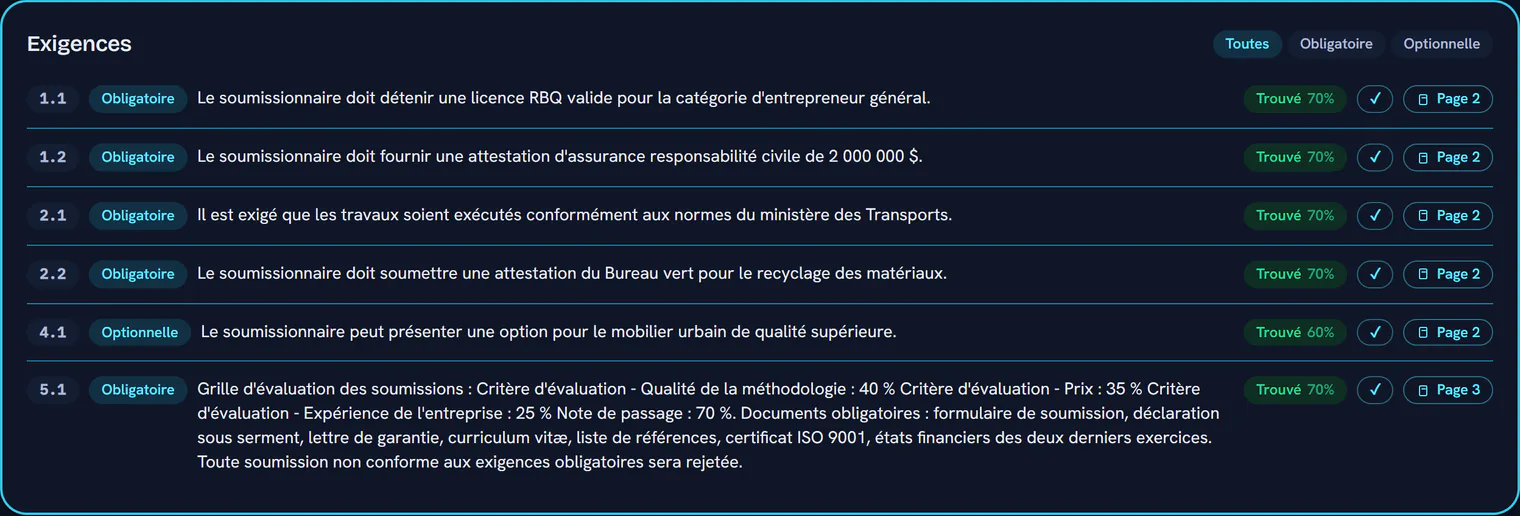
ScreenshotScreenshot of the product on a demo dataset (synthetic file) — every line points back to its source.
Analyze my dossier- Analyze a dossier
- Prepare a call for tenders
- Verified price grid
- Automatic checklist
- Submission-ready exports
- Document · page citations
- Covered regions
- Your data, isolated
What do you want to do now with your tenders?
Pick the door for your next move.
Where tenders waste your time
Three mechanisms, in every dossier. And one reason to exist.
What matters is not in the main file
The rules point to an annex, the annex to a table, the table to a footnote. What commits you is read across three documents.
The same fact lives in four places
An email, a spreadsheet, a calendar, a personal note. Each one is right, and none of them is authoritative.
A rereading without a source proves nothing
Checking an answer means confronting it with the rules. Without a link to the document and the page, you reread from memory.
- Why TenderAIHUB exists
- Tenders are rarely lost on price — they are lost on what was never read in the right place. TenderAIHUB exists so that every bid decision rests on a readable line: which document, which page.
- Who are we?
- TenderAIHUB is the specialized platform for analyzing, preparing and managing tenders, with full traceability: every claim links back to its source. Learn more
What the engine surfaces
Three data points that decide a bid, pulled from the dossier.
October 157:59 p.m.
Portal local time
specification-document.pdfPage 2Lowest price
No quality threshold
specification-document.pdfPage 2$500per day
Late-delivery penalty
specification-document.pdfPage 2What you get
From your dossier to filing: what TenderAIHUB reads, what it hands back — every line with its source.
Tender, annexes and forms — 50 MB per file
Price schedules and bid tables, read cell by cell
Full submission, hierarchised sections
The delivered package: DOCX, PDF, XLSX and deposit notes
How TenderAIHUB changes the process
Three moves replace reading by hand, copy-pasting and rereading: read the file, price it, check it.
Read the dossier
The tender package is broken down into requirements, criteria, knock-out thresholds and deadlines — each line citing its document and page.
Price the bid
Schedules, financial statements and price grids are read as tables: cells cited, totals checked, formulas flagged.
Check before submitting
Every requirement becomes a line to tick, with the supporting document expected and a link back to its source in the package.
- Complete extraction
- Requirements, criteria, thresholds, deadlines, risks, required documents. Annexes and forms included.
- Honest states
- Found, not found, ambiguous, inferred. Inferred stays below 50%.
- Built-in OCR
- Scanned PDFs, French, English and Spanish OCR, page by page.
- Submission-ready exports
- JSON, CSV/XLSX, DOCX and PDF. Summary, checklist, matrix, risk register.
- Teamwork
- Owner, Admin, Analyst, Contributor. Human validation, item by item.
- Deterministic engine, LLM on tap
- Offline by default. In hybrid mode the LLM only handles exotic documents — and its output is re-verified.
- Issuing calls for tenders
- Describe the need. Specifications, weighted grid, schedule and documents to attach, delivered ready to publish.
Why not just an LLM?
A general-purpose LLM summarizes; TenderAIHUB proves. Three differences that hold up in production.
- Every line cites its source
- Document, page, excerpt — a TenderAIHUB claim opens and verifies. An LLM summary gets reread from memory.
- Deterministic by default
- The engine runs offline and walks the dossier reproducibly. In hybrid mode the LLM only touches exotic documents — and its output is re-checked.
- The decision stays human
- Four roles, item-by-item validation server-side. The LLM assists; it does not decide for you.
Before / After
By hand
- Read 200 pages, highlight, copy the requirements into a file.
- Hunt through four files for last week's decision.
- Reread one last time, hoping nothing was missed.
With TenderAIHUB
- Drop in the dossier: the requirements come out, each with its document and page.
- One list of decisions, where every line links back to its source.
- A checklist that says what is still open, right up to filing.
What you gain
Time, a source on every line, every requirement checked off, and dossiers that stay inside your organization.
- Time back for writing
- The reading that comes before the writing happens once. Later versions get compared, not reread.
- Every statement, its source
- A line is verified by opening the document at the cited page, instead of rereading from memory.
- What is required, checked off
- Every requirement in the rules becomes a line to check off. Writing that fails says so, instead of letting a section look filled.
- Your dossiers stay with you
- Isolation by organization: your documents never share space with another client's, and every access follows a role.
Who it's for
Two sides of the same table: those who issue the call for tenders, those who answer it.
You issue the call for tenders
The specifications, the weighted grid and the schedule are drafted from one record.
Municipalities
— You issue the call for tenders: the specifications, the grid and the schedule are drafted from one record.Ministries
— Long dossiers, many annexes, and an audit trail required at every step.Nonprofits and agencies
— Few hands, many dossiers: the reading happens once, the checklist follows through to submission.
You answer a call for tenders
Decide on the dossier's actual requirements, and submit with a checklist that follows through to filing.
Private companies
— Deciding to bid rests on the dossier's actual requirements, not on the buyer's reputation.Consulting firms
— Compliance matrix and submission structure, without hand-reading 200 pages.Specialized suppliers
— Certifications, insurance and guarantees required, spotted in every dossier.
Regions covered
The engine adapts to the portal: tender formats, organizations and languages differ from one region to the next.
Your dossiers stay inside your organization
Organization isolation, role-based access, every claim linked to its source — nothing leaves, nothing mixes.
- Security
- Protected access. Role-based permissions.
- Privacy
- Your data never leaves your organization.
- Traceability
- Every claim, its document, its page, its excerpt.
- Organization isolation
- Your dossiers never sit alongside other clients'.
- Human validation
- The final decision stays human.
One credit, one submission.
Consumed only if the analysis succeeds.
Monthly
$129
/month 10 analyses
- OCR included
- Requirements + criteria
- Compliance checklist
- PDF / XLSX exports
- Email support (24-48 business hours)
Quarterly
$357
/3 months 30 analyses
- OCR included
- Requirements + criteria
- Compliance checklist
- PDF / XLSX exports
- Email support (24-48 business hours)
Pay per tender
$49
1 analysis
- OCR included
- Requirements + criteria
- Compliance checklist
- PDF / XLSX exports
- Email support (24-48 business hours)
Billing regionCanada
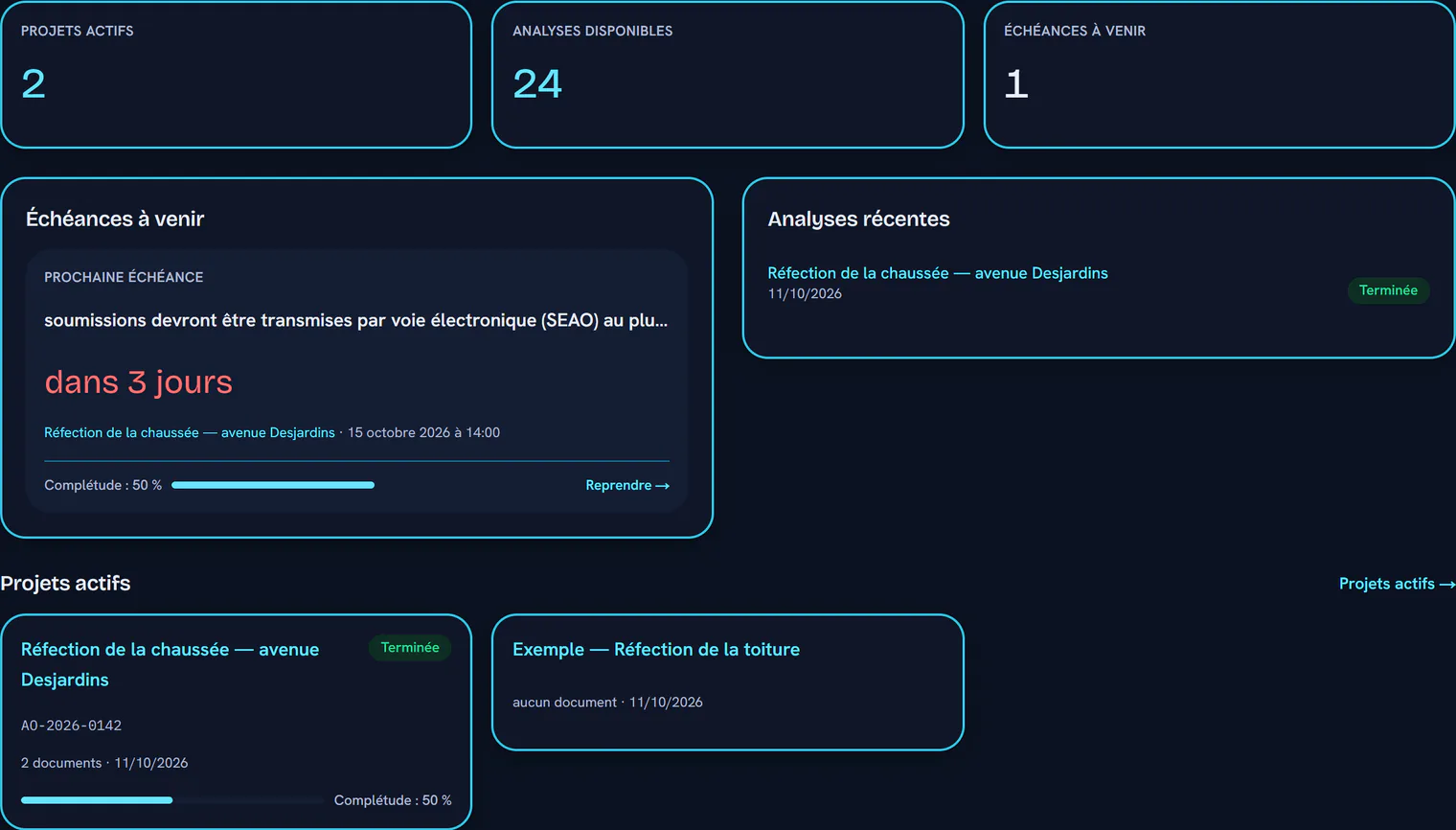
The dashboard
From the raw document to the verified checklist, in one place.
Frequently asked questions
Does TenderAIHUB replace my bid team?
No. TenderAIHUB structures and shortens document reading, but human and legal validation remains essential.
What if the PDF is scanned?
Automatic OCR (French, English, Spanish) extracts the text, with a per-page confidence indicator.
Can I change the interface language?
Yes — French, English and Spanish, without losing your work. Citations stay in the source document's language.
How does billing work?
Monthly or quarterly subscription, or a one-time purchase per submission. One unit is consumed exactly once per successful complete analysis.
Can I change plans?
Yes. Plan changes are managed from the Subscription page; credits already granted remain usable until they expire.
What happens to a credit for a failed analysis?
It is automatically returned to your balance. Failed analyses can be relaunched at no charge.
Are my documents safe?
They are stored per organization, isolated from other clients, with server-side permission checks. PDF content is treated as data, never as instructions.
Your next dossier, already read
Create your account, drop in a dossier: the requirements come out, each with its source.